

The Truth About First-Axis Leveling
First-axis is a hotly debated topic. Does it matter? Can you set up your bow with a natural cant?
This is what we try to address here.
The Three Axes
First, let's define the three axes.
Your bubble is a gauge. You hold the bow so the bubble is level on every shot, the same way every time. The three axes are about making sure "bubble level" means what you think it means.
- First-axis: how the sight's rail (the bar your pin or scope rides on) is tilted left or right relative to the bow and string. This sets which plane you shoot in, and it is what this article is about.
- Second-axis: when your bubble reads level, your rail is straight up and down with gravity. In other words, second-axis lines up your elevation adjustment with gravity.
- Third-axis: keeps your level square to your line of sight. This is what keeps the bubble reading correctly when you tip the bow up or down for an uphill or downhill shot.
Everything below assumes your second-axis and third-axis are already set correctly.
Why Leveling for Every Shot Matters
Before we get to first-axis specifically, it helps to know why a tilted (canted) bow misses to the side at all. This part is axis-agnostic. It is just about what a tilt does to a given shot, whether that tilt comes from a mis-set second-axis, a mis-set third-axis, or simply not holding the bow the same way every time.
When you aim at a target, your sight is set so the arrow leaves on an arc and drops back down onto your aim point. The farther the shot, the more the arrow drops on the way there, and the more your sight moves down on the rail to make up for it. The figures below are the actual drop chart for my hunting bow: the arrow drops about 69″ by 60 yards and 218″ by 100.
Now tilt the bow a little. The drop your sight is correcting for tilts along with the bow, so part of it now points sideways instead of straight down, and the arrow lands off to the side. Because the arrow drops more the farther you shoot, the sideways miss grows with the square of the distance.
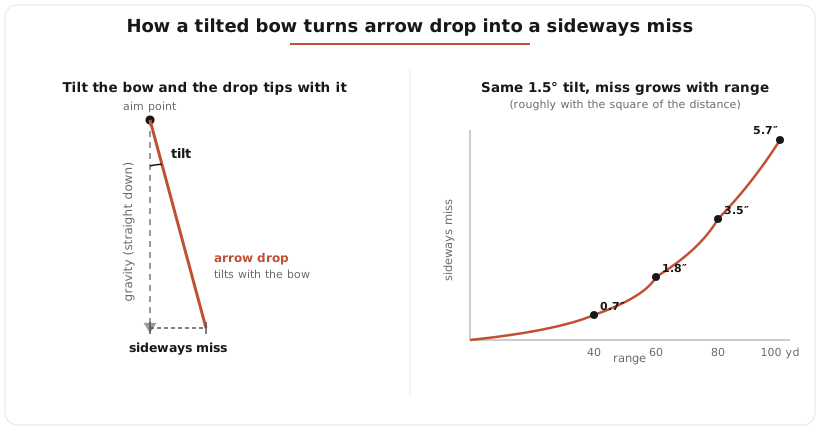
Here is what a fixed tilt costs, run off those drops:
| Range | Arrow drop | 0.5° tilt | 1.5° tilt | 2.5° tilt |
|---|---|---|---|---|
| 20 yd | 4″ | 0.0″ | 0.1″ | 0.2″ |
| 40 yd | 27″ | 0.2″ | 0.7″ | 1.2″ |
| 60 yd | 69″ | 0.6″ | 1.8″ | 3.0″ |
| 80 yd | 132″ | 1.2″ | 3.5″ | 5.8″ |
| 100 yd | 218″ | 1.9″ | 5.7″ | 9.5″ |
| 120 yd | 328″ | 2.9″ | 8.6″ | 14.3″ |
How much is a degree of tilt? Archery bubbles are not marked off in degrees and they vary, but a clearly visible lean of a quarter to a half bubble is somewhere around half a degree to a degree. That sounds like nothing, but as the table shows it is worth real inches at distance. This is the whole reason a level matters: it is what keeps your cant the same on every shot.
The math, if you want it
Call the arrow's drop at a given range D, and the tilt φ. The sideways miss is:
sideways miss ≈ D × sin(φ)Because sin(1°) ≈ 0.017, each degree of tilt is about 1.7% of the drop, sideways. The drop D grows with roughly the square of the range, which is why the miss grows so fast.
There is a small vertical effect too (the shot also lands a little low, by D × (1 − cos φ)), but for normal leveling errors that is a few hundredths of an inch and you can ignore it. It only matters once the tilt gets large.
The Debate
Professional archers like Paige Pearce and Tim Gillingham talk about leveling their bow where it sits comfortably at full draw, at a slight natural cant, instead of forcing it straight up and down. The objection you hear is that a canted setup has to give you windage error at distance.
First, the key idea this whole thing rests on: once the arrow leaves the string, gravity is the only thing steering it sideways-vs-down, and gravity pulls straight down. So the arrow flies in a vertical plane, the one that runs straight up and down through its launch line. That plane is defined by gravity, not by how the bow is rolled. "Above the arrow" means above relative to gravity, straight up, every time.
To be fair to the objection, first-axis still has to be set correctly. Your rail has to be plumb to that gravity-defined plane you actually shoot in, and your bubble has to match it, or your windage will drift as you dial up and down. The debate is not about skipping that. It is only about whether the plane you shoot in can be your natural cant instead of dead level.
It can, and here is why.
The Idea
As long as your sight system sits and tracks directly above the arrow, straight up along gravity, the arrow goes where you aim, no matter how the bow is rolled. Remember the arrow only ever drops straight down, so "above" is measured against gravity, not against the bow. The clearest example is a crossbow: it lies flat, nowhere near vertical, but the scope sits right above the bolt, square to gravity, and it shoots fine. The roll of the bow itself does not matter. What matters is where the sight system sits relative to the arrow and to gravity.
On a compound, sighting in takes care of the front sight: when you adjust windage to hit center, you are putting the pin right over the path of the arrow, whatever cant you hold.
The Catch: the Peep
The peep is the problem. It rides on the string, not on the riser, so when you cant the bow the peep no longer sits directly over the arrow. You can move the front pin back over the arrow by sighting in. You cannot do that with the peep. So the real question is how much that costs.
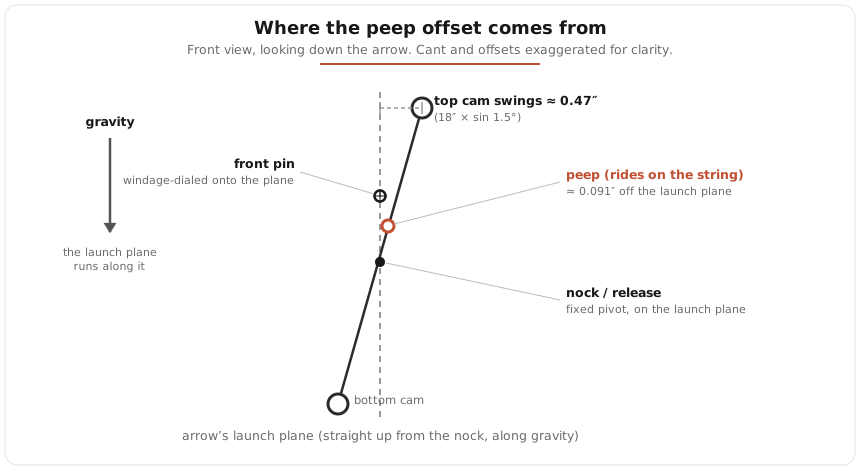
Take an ARC 34 with a Spot Hogg Boonie, which gives about 1.5° of first-axis adjustment. Crank it all the way over. At full draw the bow is 36″ from cam to cam, so each cam is about 18″ from the arrow. Tilting the bow 1.5° swings the top cam sideways about half an inch. The peep rides partway up the string, so it moves only a fraction of that, landing around 0.09″ off to the side.
The math, if you want it
The top cam swing is 18" × sin(1.5°) ≈ 0.47". The peep sits about 6/31 of the way up the string from the release, so it moves 0.47" × (6/31) ≈ 0.091".
A shortcut: the peep offset is just its height above the nock times the sine of the cant. A peep about 3.5″ above the nock at 1.5° gives 3.5 × sin(1.5°) ≈ 0.091", the same answer.
What Sighting In Does to That Offset
When you sight in the canted bow at 40 yards, you move the pin until the arrow hits your aim point. You are not putting the pin straight over the arrow. You are putting it wherever it needs to be so that your line of sight (peep through pin) and the arrow's path cross at 40 yards.
Because the peep is off to the side by 0.09″, sighting in ends up pushing the pin nearly the same amount, so your line of sight runs almost parallel to the arrow's path, just barely angled in to meet it at 40 yards. Almost all of that offset gets absorbed when you sight in. What is left over is tiny.
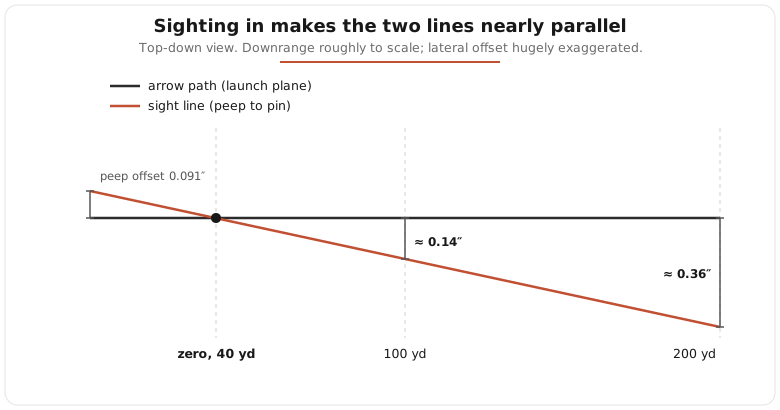
Past your zero, the two slowly spread apart:
| Range | Windage error |
|---|---|
| 40 yd (zero) | 0″ |
| 100 yd | ≈ 0.14″ |
| 200 yd | ≈ 0.36″ |
The math, if you want it
With the peep offset d and the zero range R₀, the leftover windage at range R is:
error = d × (R − R₀) / R₀Your sight radius (peep-to-pin distance) does not appear. The peep offset and the zero range are all that set it.
Why the Error Stays So Small
A maxed-out 1.5° natural cant is worth 0.14″ at 100 yards and 0.36″ at 200. That is smaller than an arrow shaft at 100 yards.
A second-axis error tilts the whole bow, so all of the arrow's drop (~218 inches by 100 yards for my bow) gets thrown partly sideways, and even a 1° bubble error is worth several inches at 100. A natural cant that is set up right keeps your shooting plane lined up with gravity, so none of that drop gets thrown sideways. The only thing left off to the side is the peep.
Takeaway
Your rail has to be plumb to the plane you shoot in (first-axis), your bubble when centered has to align the rail with gravity (second-axis), and your bubble has to be square with your line of sight (third-axis).
However, the actual orientation of your bow relative to the plane you shoot in is not important. Your first-axis setting can safely be set to what is most comfortable and repeatable for you.